
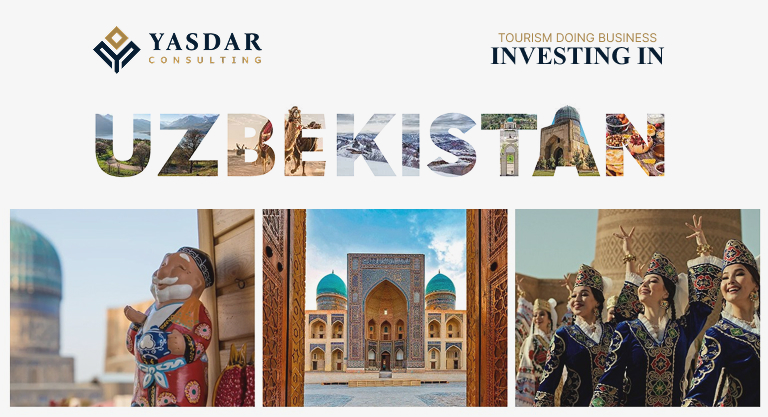
In recent years, Uzbekistan has been consistently developing tourism as one of the priority sectors of its economy. According to data from the State Statistics Committee of the Republic of Uzbekistan (stat.uz) and the Committee on Tourism, the number of international arrivals has shown steady growth, creating stable demand for hotel infrastructure.
However, further growth in the investment potential of this rapidly developing sector of the national economy is impossible without fundamental shifts aimed at increasing the investment attractiveness of Uzbekistan’s hotel, restaurant, and other types of tourism businesses.
The key factors behind the growing relevance of the challenge of improving the investment attractiveness of the republic’s tourism industry are:
- the active role of the state in institutional strengthening and functional development of the industry;
- unprecedented simplification of regulatory and visa procedures for international tourists;
- large-scale infrastructure projects in destinations popular with foreign guests;
- significant expansion of access for foreign guests to unique cultural and historical heritage sites in the country.
- fundamental changes in investment support for domestic hotel businesses.
- Macroeconomic Indicators of Growth in the Tourism Sector
According to data from Stat.uz and the United Nations World Tourism Organization (UNWTO), the Uzbek government has set targets for tourism development through 2030 that envisage significant growth in:
- the total number of international and local tourists;
- total revenue of hospitality businesses;
- employment of the working-age population in tourism and hospitality.
The rapid growth of Uzbekistan’s tourism industry makes the travel services market predictable in the long term and creates conditions for capital-intensive projects in the hotel business.
- Drivers of Growth in Tourist Flows
Development of Transport Infrastructure
The modernization and expansion of the international airports in Tashkent, Samarkand, Bukhara, and Khiva, as well as the launch of new direct flights to remote tourist destinations in the republic, are improving the country’s transport accessibility for foreign travelers.
Simplification of the Visa Regime
Uzbekistan offers a visa-free regime for citizens of more than 90 countries, and has simplified electronic visa procedures, significantly reducing barriers to inbound foreign tourism.
UNESCO Cultural Heritage
The cities of Bukhara and Khiva are included in the UNESCO World Heritage List, and Samarkand has been declared the world capital of cultural tourism in 2024, which ensures stable interest from international visitors and tour operators.
- Government Support for Investors
The hotel industry in Uzbekistan enjoys targeted government support:
- Tax Incentives: in accordance with Presidential Decree No. UP-5611 of January 5, 2019, investors contributing to the development of hotel infrastructure are exempt from a number of taxes.
- Subsidies and Green Standards: Resolution of the Cabinet of Ministers of the Republic of Uzbekistan No. 587 of September 27, 2021 provides for subsidizing the costs of entrepreneurs for the implementation of environmental standards and certification of hotels.
Simplification of Land and Licensing Procedures: Decree of the President of the Republic of Uzbekistan No. UP-6003 of May 28, 2020, aims to reduce administrative barriers to the implementation of investment projects.
Tourism Clusters: The development of regional clusters (such as the Samarkand Tourism Cluster) allows investors to join projects with already established infrastructure.
- Hotel Real Estate Market
According to statistics from the Tourism Committee, the hotel market is in a phase of active expansion. https://stat.uz
Estimated hotel room stock and occupancy in 2023:
- Tashkent: approximately 5,500 rooms, average occupancy ~70%;
- Samarkand: approximately 3,200 rooms, occupancy ~75%;
- Bukhara: approximately 2,800 rooms, occupancy ~68%;
- Khiva: approximately 1,500 rooms, occupancy ~65%.
As of last year, the hotel market in Uzbekistan showed significant growth in room capacity thanks to both local and international operators. In 2024, there were 2,383 hotels and similar accommodation facilities in the country with a total capacity of 38,075 rooms and 79,469 beds.
The number of hotels rose by 71.8% compared to 2023, and the number of rooms increased by 11%. The total number of tourists accommodated was 2,864,300, an increase of 13.5%.
Dynamics of International Hotel Brands:
The growth in the number of rooms managed by international chains in Uzbekistan shows rapid growth: as of late 2025, the international accommodation stock reached about 4,473 rooms, an increase of 272% since 2020. https://one.uz
In 2025, a number of large hotels opened, including Swissôtel Tashkent, Wyndham Garden Tashkent Airport, Ramada Encore by Wyndham Zomin, and J.W. Marriott Hotel Tashkent. https://one.uz
As of the end of 2025, no consolidated data on average occupancy in individual cities has been officially published in open sources. However, the growth in the number of guests and tourists suggests that the occupancy rate is likely to increase compared to 2023 (70%+ in Tashkent, 75% in Samarkand, etc.), especially considering that in 2025, more than 10.7 million foreign travelers arrived in Uzbekistan, which is significantly higher than in previous years.
Key Trends in the Development of the Hotel Market in 2024–2025:
- An increase in the total number of rooms and the number of hotels.
- Strong presence of international chains and the launch of premium segment facilities. https://one.uz
- Growth in the number of tourists to record levels in 2025, creating increased demand for hotel services. https://euronews.com
The average daily rate (ADR) varies between $80 and $150, depending on the city and segment of the tourism sector. In 2023, ADR grew by 10–15% compared to the previous period.
These figures reflect the widespread expansion of accommodation infrastructure in Uzbekistan as a result of increased tourist traffic.
Project Pipeline:
More than 150 hotel facilities are currently under construction or in the design stage, which should add about 10,000 rooms by 2027. Projects are mainly concentrated in Tashkent and Samarkand.
- Financial Models and Profitability
Typical investment cases show competitive returns:
- Business hotels (Tashkent): IRR in the base case scenario is around 18%.
- Historic and luxury hotels (Samarkand): IRR of around 15%
- Mountain and eco-resorts: IRR of around 20%, depending on the season.
- Calculations are based on estimates from consulting companies in the hospitality and construction sectors.
- Risks and Ways to Mitigate Them
Key risks for foreign investors include seasonality of demand, currency fluctuations, and staff shortages. In practice, these risks can be mitigated by:
- diversifying services (MICE, event tourism);
- the use of currency hedging;
- investment in staff training and partnerships with relevant education providers.
- Conclusions and Recommendations
The hotel business in Uzbekistan combines high growth potential and active government support. The most effective market entry strategy is to cooperate with local partners (joint ventures), conduct comprehensive due diligence, and select a segment that takes into account regional specifics.
Main Official Sources
- State Statistics Committee of the Republic of Uzbekistan — https://stat.uz
- Tourism Committee of the Republic of Uzbekistan — https://tourism.uz/ru
- National Database of Legislation of the Republic of Uzbekistan — https://lex.uz/ru
- UNWTO — https://www.unwto.org
- IFC / World Bank — https://www.ifc.org/
- EuroNews — https://ru.euronews.com